
Final Presentation available for NAVISP EL1-088 quinquies “Proof of concept of advanced navigation algorithms based on factor graph optimization”
Last Updated: Created at:
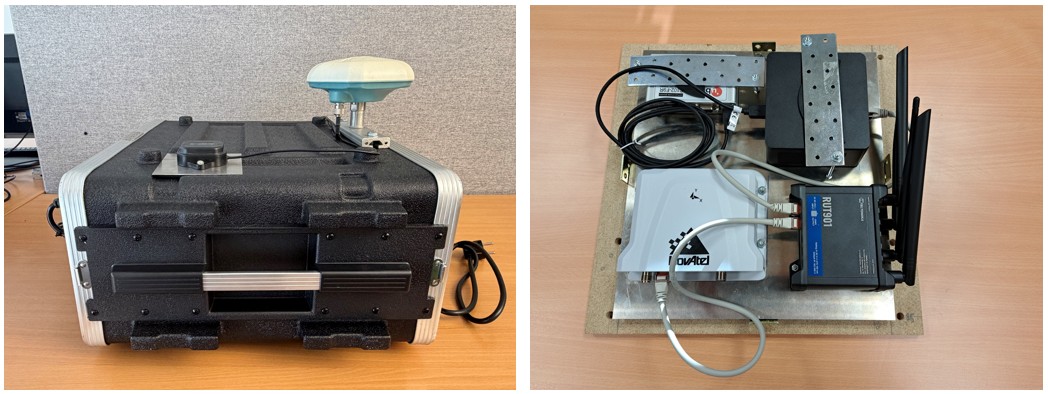
On 4th November 2026, OHB Austria, together with Graz University of Technology, presented the results of NAVISP EL1-088 quinquies. The activity investigated the applicability of factor graph optimisation (FGO) to GNSS-based positioning, navigation and timing (PNT), with particular attention to its potential performance benefits and computational requirements.
The team developed a flexible FGO-based navigation system supporting single point positioning (SPP), precise point positioning (PPP), real-time kinematic (RTK) positioning and inertial measurement unit (IMU) integration. To enable a direct comparison of the estimators, the same datasets were processed using FGO-based fixed-lag smoothing and Extended Kalman Filter (EKF)-based filtering, with identical preprocessing, observation models and stochastic models.
Evaluation included 18 field tests across suburban, light-urban and deep-urban environments around Graz, Austria, using two receiver classes and six sensor configurations. Seventeen tests were included in the final analysis, complemented by publicly available smartphone and urban-navigation datasets.
FGO achieved positioning accuracy broadly comparable to EKF-based filtering across the evaluated receivers, positioning modes and environments. No consistent overall performance advantage was established. However, the results indicated potential benefits for a mass-market receiver in selected configurations, particularly with inertial integration and in the tails of the positioning-error distribution. Real-time processing was achieved, and a ten-second smoothing lag offered a practical compromise between computation and accuracy for the evaluated configurations.
The activity was fully funded by ESA NAVISP Element 1, whose objective is to innovate PNT technologies, products and services.
Final-presentation slides link
Final-presentation slides link