
EL1-137 - 4D Ionospheric concept/simulator to allow multilayer high precision applications
DESCRIPTION
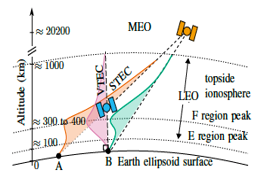
LEO-PNT systems introduce new observations that can significantly enhance ionospheric monitoring and modelling capabilities. The ionosphere remains one of the principal error sources limiting instantaneous high precision Position, Velocity and Timing (PVT) performance.
Galileo High Accuracy Service (HAS), particularly Service Level 2 (SL2), targets convergence to its final accuracy within 100 seconds. However, the current SL2 ionospheric correction approach relies on a simplified 3D ionospheric model primarily suited to ground users receiving MEO signals. This limits its ability to support rapid convergence on high-accuracy applications involving LEO-PNT observations.
C-band LEO-PNT, for which dedicated high precision ionospheric correction models do not yet exist, also needs a model to correct the ionospheric delay to achieve high accurate PVT. At 5.02 GHz, the ionospheric delay can range from approximately 0.8 m to 2.4 m under typical European ionospheric conditions, depending on satellite elevation. Such errors are incompatible with the sub-decimetre positioning performance targeted by future high-accuracy services.
At lower frequencies, the ionospheric impact becomes even more significant, affecting emerging applications based on VDES and UHF LEO systems. In addition, several current and future Earth Observation missions, particularly low-frequency SAR systems, could benefit from accurate 4D ionospheric information.
The objective of this activity is to study, design, simulate and demonstrate a high precision 4D ionospheric model capable of supporting next-generation Navigation and Earth Observation applications.
The activity will investigate how combined MEO and LEO observations can enable near-instantaneous high-accuracy positioning, targeting convergence times below 10 seconds for at least 95% of time, significantly improving upon current Galileo HAS SL2 performance.
The tasks to be performed shall include:
1. Development of a High-Precision 4D Ionospheric Model
- Define and assess advanced 4D ionospheric modelling concepts.
- Investigate the use of combined MEO and LEO observations to improve ionospheric estimation accuracy and spatial-temporal resolution.
- Quantify the resulting benefits for high-accuracy PVT applications.
- Demonstrate the achievable reduction in convergence time for Precise Point Positioning and related techniques.
2. Development of an End-to-End Simulation Framework
- Develop a simulation environment capable of generating realistic MEO and LEO observables.
- Support assessment of multiple ionospheric modelling approaches in representative operational scenarios.
- Evaluate performance both in terms of ionospheric estimation accuracy and positioning performance.
- Investigate applicability to navigation, VDES positioning and Earth Observation missions.
The main outputs of the activity will consist of:
- A high precision 4D ionospheric model architecture suitable for Navigation and Earth Observation applications.
- An end-to-end simulation tool capable of generating and processing MEO and LEO observations for advanced ionospheric and PVT performance assessment.
- Recommendations for future EU LEO-PNT systems, including potential applicability to the full Celeste and IOP constellations.
- System-level implementation guidelines, covering:
- required observation types and data products
- message design and optimisation
- ground segment and space segment infrastructure needs
It is noted that Austria expressed their opt-out for this activity (EL1-137).