
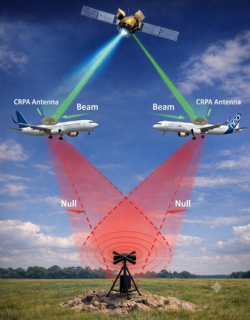
EL1-140 - Locating jammers using cooperative aircraft CRPAs
DESCRIPTION
Jamming and spoofing of GNSS-signals is a major concern, especially for aviation. Many aircrafts are impacted daily, in particular in regions which are close to conflict areas (e.g., the Baltic region and Eastern Europe). One of the main technologies to mitigate jamming and spoofing are CRPAs. Aviation standardisation organisations (Eurocae and RTCA) have initiated working groups to produce standards for CRPAs. These standards shall allow the production of CRPAs which are certified for aviation. It is expected that a large percentage of the aircrafts will deploy a certified CRPA, once available.
Although the main purpose of CRPAs is the mitigation of jamming and spoofing, the deployment of CRPAs may have other benefits, such as the concept of this project. A jamming signal will lead to a null (in the gain pattern of the CRPA) in the direction of the jammer. When the same jamming signal is received by multiple CRPAs at different locations, the directions of the nulls of the CRPAs can be used to locate the jammer.
Locating jammers using multiple CRPAs could also be performed using ground-based or space-based approaches, yet an approach using cooperative aircrafts would have several advantages. First and foremost, in a future scenario, it is assumed that a large number of CRPAs installed on aircrafts will observe the same jammer (please note that there are around 30.000 flights per day in Europe). This would be beneficial for the accurate determination of the location of jammers. Second, aircrafts operate in open sky conditions, hereby improving performance in locating jammers. Third, as CRPAs would be deployed on aircrafts for the purpose of robust navigation, the concept of locating jammers would not require the installation of additional CRPAs, hereby reducing costs. Nevertheless, the concept of locating jammers using cooperative aircraft CRPAs may also have drawbacks requiring further analysis. For instance, jamming signals typically arrive from low or even negative elevation angles, which may impact the accuracy of setting the null in the direction of the jammer.
The objective of the activity is to develop a method to locate jammers using CRPA measurements from multiple aircrafts.
The tasks to be performed shall include:
- Study of CRPA gain patterns for interference coming from low or even negative elevation angles, using a combination of analysis, simulation, and laboratory tests.
- Perform field tests (e.g., flight trials and/or static tests at JammerTest in Norway) to complement the study above.
- Develop a method to locate jammers using CRPA measurements from multiple aircrafts.
- Derive the input for simulations, e.g.:
- Select a region for which simulations shall be performed
- Derive several scenarios for the number and type of jammers and spoofers in this region, or close to this region
- Derive a realistic scenario of the aircrafts in this region (number of aircraft, altitude, flight path, banking angles, etc.)
- Derive several scenarios for the CRPA designs per aircraft.
- Execute simulations for the combinations of scenarios defined above.
- Provide a high-level design of a future operational system (considering not only CRPAs but also data-links and a processing facility).
- Conclude on the performance of the method to locate jammers using cooperative aircraft CRPAs.
The main outputs of the activity will consist of:
- Results of laboratory tests.
- A CRPA processor.
- a RF interference localisation simulator.
- A report showing performance of the RF interference localisation under relevant conditions.
It is noted that Austria expressed their opt-out for this activity (EL1-140).