EL1-147 - Compressed‑Sensing Snapshot GNSS Receiver for Low‑Power Devices
DESCRIPTION
Conventional GNSS receivers rely fundamentally on continuous Nyquist-rate sampling and substantial on-board processing, which places significant demands on power, computation, and data-handling resources. These requirements are particularly challenging for IoT nodes, nanosatellites, and autonomous sensors, where available resources are inherently limited.
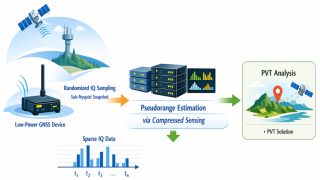
Snapshot GNSS receivers reduce continuous processing but still rely on Nyquist-rate sampling and on-board correlation. This work proposes a sub-Nyquist randomized sampling approach where sparse IQ data is sent to the cloud, reducing the amount of transmitted data and therefore lowering the power consumption of the IoT device.
Exploiting the sparsity of GNSS signals, code delays are reconstructed off-board using compressed sensing, enabling pseudorange estimation and PVT computation while reducing on-device processing complexity. A key advantage of the proposed approach is that the low-power device transmits only a compact snapshot of randomly sampled IQ measurements, significantly reducing data volume compared with Nyquist-sampled.
The objective of the activity is to demonstrate and validate a proof-of-concept cloud-assisted snapshot GNSS receiver that reconstructs pseudoranges from randomly sampled sub-Nyquist IQ measurements. The activity will quantify the trade-off between data volume reduction, receiver power consumption, and navigation performance, and compare the results against a conventional Nyquist-sampled snapshot GNSS receiver.
The tasks to be performed shall include:
- Study, design, and demonstrate a snapshot GNSS receiver based on compressed sensing.
- Collect randomly sampled IQ measurements at a low sampling frequency using a low-power device.
- Transmit the measurements to cloud-based processing for pseudorange reconstruction.
- Perform the reconstruction of pseudoranges and PVT off-board using compressed-sensing techniques.
- Compare the results against a conventional snapshot GNSS receiver operating at Nyquist sampling rates.
The main outputs of the activity will consist of:
- Survey of the state of the art on compressed sensing for GNSS
- Prototype and test report
- Performance assessment against state-of-the-art snapshot GNSS approaches
- Power and data-volume reduction analysis
- Roadmap for commercialization, including potential NAVISP EL2 activities
It is noted that no Participating State expressed their opt-out for this activity (EL1-147).