
Advanced Concept for Chip-Scale Atomic Clocks
Last Updated: Created at:
Final Presentation of NAVISP Project EL1 032 now available:
On Wednesday, October 18th, 2023, University of Neuchatel (UniNE), Swiss Federal Institute of Technology in Lausanne (EFPL) and MICOS Engineering AG presented the results of the NAVISP EL1 032 project "Advanced Concept for Chip-Scale Atomic Clocks". Over 40 people from industry and research institutes followed the interesting presentation and the subsequent interactive Q&A session.
This initiative addressed the growing demand for low-power, portable Chip-Scale Atomic Clocks (CSAC) capable of ensuring precise timing in the most challenging environments. CSACs have emerged as a crucial component in various applications, including Positioning, Navigation, and Timing (PNT) in GNSS denied environments, secure telecommunication, and timing hold-over. However, conventional CSACs, which employ alkali microcells and coherent laser-atom interaction, are hindered by constraints, such as low atomic signals, limiting their precision to the 1E-10 level at 1 second and 1E-11 level over several minutes to 1 day. The Advanced Micro-Cell Atomic Clock (AMICC) project aimed to break these constraints and pave the way for a compact, energy-efficient, and highly stable atomic clock solution.
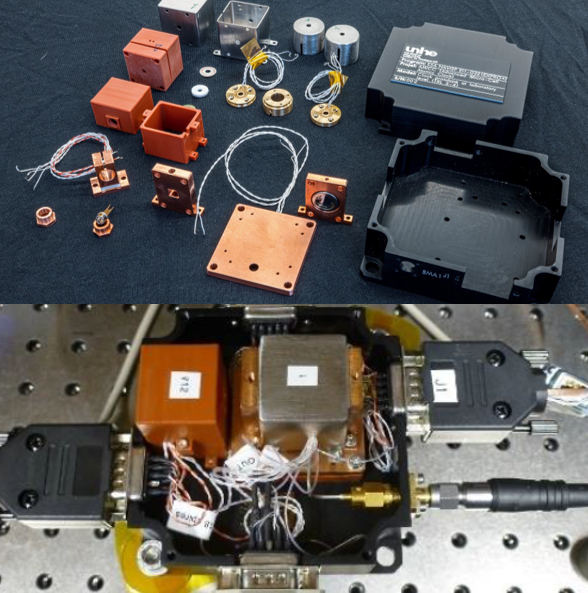
Central to the AMICC project is its innovative approach—a double-resonance scheme, marked by its simplicity. This clock architecture comprises only one laser, one microcell, and one microwave resonator, distinguishing it from recent CSAC models. A key innovation within the AMICC project is the development of a micro-loop-gap (micro-LGR) microwave resonator. Comprising two circular PCB layers with printed electrodes, this resonator boasts an impressive field uniformity at the 6.8 GHz resonance within a sub-cm volume, without requiring frequency tuning means. This approach offers the advantage of compactness and low power consumption, eliminating the need for high-vacuum atom enclosures and complex multi-wavelength or high-power laser sources found in recent CSAC models. The Physics Package demonstrator developed in the AMICC project, showcases a remarkable improvement in clock performance over existing CSAC models, with a stability of 4E-12 at one day and a minimal drift of less than 1E-12 per day.
The AMICC project presents a promising shift in the world of precision timing. It provides a practical, low-power solution for applications that demand high-precision timing under adverse conditions. Looking ahead, the project envisions future enhancements through the adoption of pulsed interrogation schemes and the optimization of rubidium microcells meeting the impressive performance of 1E-12 level and beyond in a very small form factor. The project's success underscores the significance of ongoing innovation in CSAC technology, promising a future marked by increasingly accurate and efficient timing solutions for a wide range of critical applications.
The project was carried out in the scope of NAVISP Element 1, which is dedicated to technology innovation of the European industry in the wide PNT sector.
More detailed information can be found in the slides of the Final Presentation.