
Final Presentation DroneHome2 by Omnisense
Last Updated: 18/03/2026 10:52 Created at: 04/03/2026 07:50
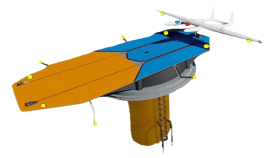
The project advanced a robust multi‑sensor navigation architecture integrating GNSS, IMU and a Local Positioning System (LPS), enabling bounded, deterministic landing performance even when GNSS becomes degraded or unavailable. Architecture, firmware and timing‑model upgrades resulted in a quantified and validated performance envelope suitable for maritime, urban and confined‑space drone operations.
Key validated results:
- Assisted GNSS landing accuracy: < 20 cm in field trials.
- GNSS‑denied landing accuracy: 30–50 cm, stable and bounded.
- UWB ranging performance: > 240 m measured range; 0.4 m signal‑strength‑dependent bias characterised.
- Clock drift behaviour identified: RPA UWB clock drift ~7×10⁻⁸, equal to ~20 m/s apparent range‑rate if unmodelled — now explicitly modelled in the navigation filter.
- Improved navigation over PX4: DroneHome solution showed stable yaw, tighter velocity convergence, and corrected altitude errors exceeding 100 m observed in PX4 logs.
- Validated LPS integration: System maintains performance across GNSS‑enabled, GNSS‑degraded and GNSS‑denied phases across six structured approach‑and‑landing sequences.
- Geometry‑dependent performance envelope: Surround‑geometry beacon configurations necessary for low DOP and bounded accuracy.
- Extensive software & RF upgrades: > 100 firmware updates, redesigned UWB RF subsystem with 16.6 dB PA gain and 4.8 dB LNA gain.
This project was co‑funded by NAVISP Element 2, supporting the maturation of European resilient PNT solutions.
As part of follow-on activity, stakeholder input is being gathered to help inform future GNSS-resilient navigation development and deployment priorities.
Access the final DroneHome-2 presentation
Review the final project presentation and results here.
Contribute to the stakeholder questionnaire
Provide input here on operational requirements, deployment contexts, and integration priorities for resilient navigation architectures.