
Final Presentation RIPTIDE Phase 2
Last Updated: 26/01/2026 11:12 Created at: 22/01/2026 08:50
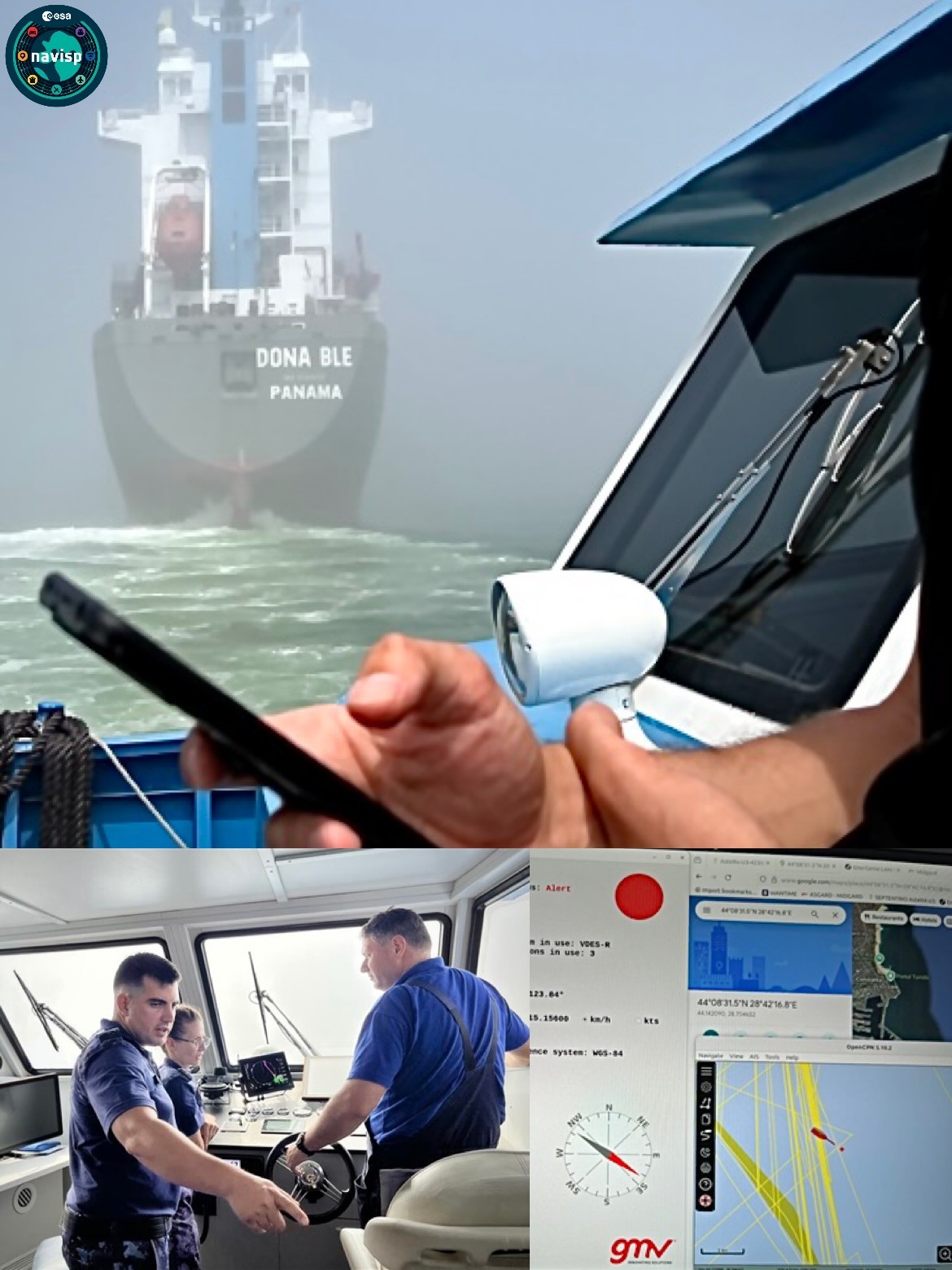
On 20 January 2026, GMV Romania and its partners presented the results of NAVISP project EL3‑026 “RIPTIDE Phase 2”, focused on developing and validating a resilient PNT demonstrator tailored to the Black Sea and Lower Danube region.
The project aimed to design, implement, and field‑test an integrated Monitor & Protect solution as a response to increasing GNSS vulnerabilities in one of Europe’s most geopolitically sensitive maritime regions.
The demonstrator development was completed through a structured technical process including:
- Requirements engineering and consolidation
- System design and definition of Monitor & Protect architecture
- Implementation of VDES‑R/R‑Mode ranging and trusted navigation message distribution
- Laboratory testing and Black Sea sea‑trials
- Evaluation of performance in nominal, degraded, spoofed, and jammed GNSS conditions
- Assessment of transversal applicability beyond the maritime domain
Key results include:
- Successful demonstration of a resilient maritime PNT system, achieving TRL 6, with validated performance in real GNSS jamming/spoofing conditions encountered during live trials
- VDES‑R / R‑Mode delivered position errors below 10 metres even under strong GNSS interference
- Monitor & protect cross‑checks (Interference Check, NM Check, PVT Check) allowed autonomous detection and mitigation of spoofing and degraded GNSS
- High correlation observed between CN0, pseudorange quality, and VDES‑R positioning accuracy
- Demonstrator performance confirmed via both localized degradation and coordinated attack scenarios using Skydel‑based spoofing
- A clear architecture for Pilot Phase defined: Light, Intermediate, and Advanced implementations
- Identification of high‑priority transversal domains such as Search & Rescue, Emergency Management, Aviation/Drones, Road and Rail transport
The project was fully funded by NAVISP Element 3, supporting collaboration in innovative PNT solutions for institutional users. A Pilot Phase (Phase 3) and an operational roll‑out (Phase 4) are proposed as next steps.
The final presentation slides can be found here.