
122 - Acoustic arrays for Drones localization and identification
DESCRIPTION
Drones, or Unmanned Aerial Vehicles (UAVs), have evolved from defence applications into versatile platforms used across industries. They can fly autonomously or via remote control and are equipped with sensors and payloads for tasks such as crop monitoring, infrastructure inspection, environmental surveillance, logistics, and emergency response. As drone technology advances, features like AI, real-time analytics, and swarm coordination are enabling smarter, more adaptive aerial systems.
With growing drone usage, localization and identification have become critical—whether for monitoring legitimate operations or detecting malicious intent. Traditional methods for tracking and detecting drones include radar and RF signal tracking. While radar is effective, it is easily detectable and, hence, it can be circumvented. RF monitoring works well unless drones operate silently, without transmitting signals—a trend seen in Silent Drones.
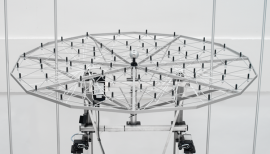
In such cases, acoustic noise becomes the only detectable signature. Acoustic surveillance, widely used underwater, is now being explored for aerial drone detection. This activity proposes a large-scale acoustic array—thousands of sensors—to detect, localize, and identify drones based on their sound emissions, typically generated by the propellers’ blades. Early demonstrations using 64 microphones in controlled environments have shown promising results in tracking drone movement (see for example “Flight path tracking and acoustic signature separation of swarm quadcopter drones using microphone array measurements". Quiet Drones conference, Paris 2020”).
The objective of this activity is to study, design, and demonstrate various identification and localization techniques, for drones and UAVs, using the acoustic signature of the airborne object.
The tasks to be performed shall include:
- Design of a Ultra-large acoustic array and a high-speed processing unit;
- Design of algorithms that exploit the ultra-large acoustic array to estimate the AoA of the drones’ acoustic noise;
- Implementation of localization algorithms based on the AoA estimates from multiple acoustic arrays;
- Implementation of AI-empowered algorithms to identify, among the others, the drones’ size and type;
- Validation and experimentation of the system in real-life environment.
The main outputs of the activity will consist of:
- Design Justification File (DJF) that contains a review of the State-of-the-Art and the system design;
- Hardware and Software implementation;
- Test report
It is noted that no Participating State expressed their opt-out for this activity (EL1-122).