
126 - Approximate Computing for Low-Power GNSS Signal Processing
DESCRIPTION
Global Navigation Satellite Systems (GNSS) play a crucial role in providing accurate positioning, navigation, and timing information for a wide range of applications, ranging from daily mobile phone use to infrastructure and military activities. Nevertheless, GNSS receivers often require considerable computational resources to process the received GNSS signals, especially during the correlation process between the input signal and the local replica signal. As these systems evolve toward more energy-efficient processing solutions, new methods must be employed in a way to achieve the right balance between accuracy, speed, and power efficiency.
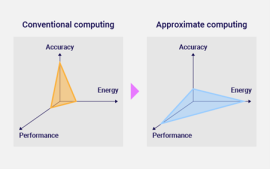
Approximate Computing (AxC) provides approximate results within an acceptable precision for the intended application, offering the advantage of considerably reducing energy consumption. This is achieved by using specially designed logical circuits, such as approximate adders and multipliers, that simplify calculations by trading off some accuracy for lower power and faster processing. AxC can significantly extend battery life in mobile GNSS devices. This is particularly beneficial for consumer electronics, wearables, and IoT devices where power efficiency is crucial. Thanks to this feature, AxC could find use also in the acquisition and tracking of the Galileo E5 Quasipilot signal, which is designed to ease the GNSS signal acquisition process, particularly in limited Power platforms. Moreover, AxC techniques could also be relevant for spaceborne GNSS receivers, where power and processing resources are often limited. However, the challenge is maintaining accuracy within acceptable bounds.
The objective of this activity is to explore how AxC techniques can be applied to GNSS signal processing to reduce power consumption while maintaining sufficient accuracy at acquisition, tracking and PVT stages.
The tasks to be performed shall include:
- Identify the most relevant AxC for GNSS signal processing.
- Development of a prototype of a GNSS receiver using AxC and exact computations.
- Tests to characterize the performance of the receiver (in terms of power consumption, accuracy, correlation degradation, etc.).
Note that as the budget is limited, data from ESA Navigation Laboratory can be provided and can be replayed on the AxC GNSS receiver from different environments: open sky, urban, and jamming environments.
The main outputs of the activity will consist of:
- Technical Notes to describe the tradeoffs and the design
- Prototype of a complete GNSS receiver using AxC (acquisition, tracking and PVT). The receiver does not need to work in real time, but it needs to provide two modes (nominal mode and AxC-mode). It shall provide:
- Bit grabber to collect IQ samples from live data and playback from a laboratory (e.g. a USRP and a GNSS antenna);
- Test equipment to Control and Monitor GNSS receiver and the bit grabber.
It is noted that no Participating State expressed their opt-out for this activity (EL1-126).