
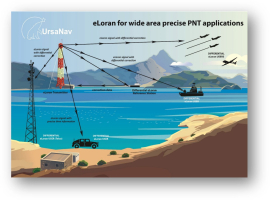
132: Development and Validation of Flexible eLoran/GNSS signal simulator
DESCRIPTION
Global dependence on GNSS for PNT has exposed threats from jamming, spoofing, interference, and space‑weather effects. These threats are now widely recognised by defence, maritime, aviation, and critical infrastructure stakeholders as a systemic risk to safety and national resilience.
In response, eLoran has re-emerged internationally as a terrestrial, high‑power, low‑frequency complementary PNT system, offering fundamentally different propagation characteristics and robustness against GNSS‑specific threats. Recent international initiatives, including strong leadership by the Republic of Korea, UK and France demonstrate renewed momentum towards operational eLoran deployment and multinational interoperability, particularly as part of a resilient PNT architecture combining GNSS plus terrestrial backups.
A critical enabler for eLoran adoption is the availability of high-fidelity, flexible signal simulators.
Previous work (Johnson, Gregory & Swaszek, Peter & Shalaev, Ruslan. (2009). Development of an Integrated GNSS-eLoran Signal Simulator and NAVISP EL1-080) has demonstrated the feasibility and value of integrated GNSS–eLoran simulators. However, these solutions were hardware centric and monolithic, region-specific (e.g. CONUS-focused), limited test scenarios (e.g. only static mode), not easily adaptable to evolving eLoran standards, modern digital architectures, or modular GNSS simulator coupling.
There is therefore a need for a next generation of flexible eLoran signal simulators, designed from the outset to:
- Be easily synchronised and coupled with existing GNSS simulators,
- Support complex and diversified test scenarios, including modelling of eLoran propagation (e.g. terrain type, urban effects, groundwave/skywave interaction, coastal boundaries, time of day variability),
- Enable future evolutions of eLoran specifications and multinational deployment concepts.
This activity offers a natural synergy with the NAVISP EL3-036bis activity “UK PNT Digital Twin Environment Development – Update Phase 2”. The datasets generated by the proposed eLoran simulator, especially from the record & replay unit, could support future validation steps within the PNT Digital Twin, enhancing the modelling of hybrid PNT architectures and terrestrial resilience layers
The objective of this activity is to design, implement, and validate an eLoran Signal Simulator synchronised with GNSS simulators, enabling the end-to-end testing and validation of hybrid GNSS–eLoran PNT solutions under realistic operational conditions, future‑proof system evolution, and resilient PNT testing for manufacturers, integrators, and service providers.
The proposed activity introduces a modular, synchronisation centric eLoran signal simulator in which eLoran operates as a signal source tightly aligned with GNSS simulators.
The tasks to be performed shall include:
- Review of eLoran Signal Definitions: a review of the current status and evolution of eLoran signal definitions. This task will identify the different signal formats currently under consideration and define the requirements for a flexible signal generation framework capable of supporting present and future eLoran signal structures.
- System Architecture and Signal Generation Core: design and implementation of a software-defined signal generation core and overall HW simulator architecture, enabling flexible scenario configuration and synchronisation with GNSS simulators through standard timing interfaces (e.g., 1 PPS and frequency references).
- High-Fidelity Propagation Modelling: Development of a configurable propagation model, including ground-wave propagation, skywave effects and ground/skywave interference, with particular attention to urban environments and terrain-dependent conditions (urban, rural, maritime, mountainous, desert, Arctic).
- Multi-Chain and Multi-Time base Simulation: implementation of support for multiple chains, each synchronised to its respective UTC(k) national timing standard, and simulation of multiple GNSS time bases corresponding to different GNSS constellations.
- End-to-End Validation Capabilities: development of an eLoran/GNSS Receiver Analysis Tool and a record and replay unit, enabling end-to-end validation of the simulator and testing of hybrid PNT algorithms.
- Simulator Fidelity Validation: validation of the simulator by comparing simulated signals with live signals collected in representative environments.
The main outputs of the activity will consist of:
- A functional Signal Simulator prototype, a unit for record and replay of eLoran and GNSS signals, an eLoran/GNSS Rx Analysis Tool enabling end-to-end validation
- A configurable eLoran propagation modelling framework, including urban and ground/skywave interaction models
- A report on current and emerging eLoran signal definitions
- Validated integrated GNSS–eLoran test scenarios
- A EL1 → EL2 roadmap, identifying steps toward higher TRL equipment
It is noted that Italy expressed their opt-out for this activity (EL1-132).