
134: All-weather Laser Timing and Ranging Links for Optical PNT Systems
DESCRIPTION
Optical laser communication links from satellite to ground are affected by atmospheric conditions. When penetrating through clouds, optical signals suffer from power degradation up to complete loss of the satellite-to-ground link. As a result, optical ground stations (OGS) as used in the OpSTAR activity are not able to establish optical links continuously but will instead have data gaps. The availability of optical time synchronisation and ranging data is therefore dependent on the location of an OGS and the local weather conditions.
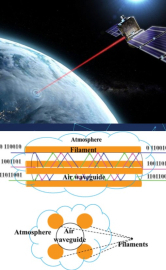
Solutions to enhance the performance of optical communication systems in cloudy conditions are proposed in current literature (see the Reference Documents paragraph below). These studies have successfully proven in laboratory environments that penetration through fog and clouds is possible using Femtosecond Laser Filaments. The filament creates an air waveguide that displaces water droplets in its immediate vicinity to create a cylindrical channel within which the laser signal beam can travel unobstructed.
The objective of the proposed activity is to study and demonstrate the use of innovative signal generation techniques for the transmission of optical timing and ranging signals in all-weather conditions.
The tasks to be performed shall include:
- suitability analysis for cloud/fog penetration techniques applied to laser communication in future PNT systems
- demonstration of selected cloud/fog penetration technique(s) in a laboratory environment with a focus on long-range experiments suitable for beam transmission at optical ground stations used for ground-satellite laser communication
- demonstration of the feasibility of applying the technique for transmission of timing and ranging signals in all-weather conditions in outdoor experiments, including consideration of high-power laser safety and security constraints (e.g. with aviation authorities)
The main output of the activity will consist of:
- Survey of current studies and suitability analysis of cloud-clearing laser signal generation techniques applied to future optical navigation systems such as OpSTAR
- Test reports comparing the performance of optical signal transmission using laser signals with and without cloud clearing in different atmospheric conditions, including experimentations in real-world scenarios (e.g. using drones as laser reception terminals)
- Roadmap for TRL increase of the new techniques for usage in future PNT systems, including potential NAVISP EL2 activities.
Reference Documents for this activity are:
- RD1: Schimmel et al. 2018: Free space laser telecommunication through fog, Optica 5, 1338-1341, https://doi.org/10.1364/OPTICA.5.001338.
- RD2: Wang et al. 2023: Structured light signal transmission through clouds, J. Appl. Phys. 133 (4): 043102, https://doi.org/10.1063/5.0129902.
- RD3: Li et al. 2024: Real-Time Demonstration of Multi-Gigabit/s Free- Space Optical Communications Employing Femtosecond Laser Filaments in Complex Environment, J. Lightwave Technol. 42, 4402-440, https://opg.optica.org/jlt/abstract.cfm?uri=jlt-42-13-4402.
- RD4: Moreno 2024: Long range filamentation for cloud clearing, Chapter 5 of Phd Thesis, https://doi.org/10.13097/archive-ouverte/unige:180749, using equipment and experiments conducted in the frame of H2020 ID 737033 "Laser Lightning Rod project (LLR)", see https://llr-fet.eu/
It is noted that Italy expressed their opt-out for this activity (EL1-134).