
Optimal Data Dissemination Demonstrator to enable precise positioning of the Mass-Market
Last Updated: 06/02/2023 09:07 Created at: 06/02/2023 09:06
Final Presentation of NAVISP Project EL1 036 now available:
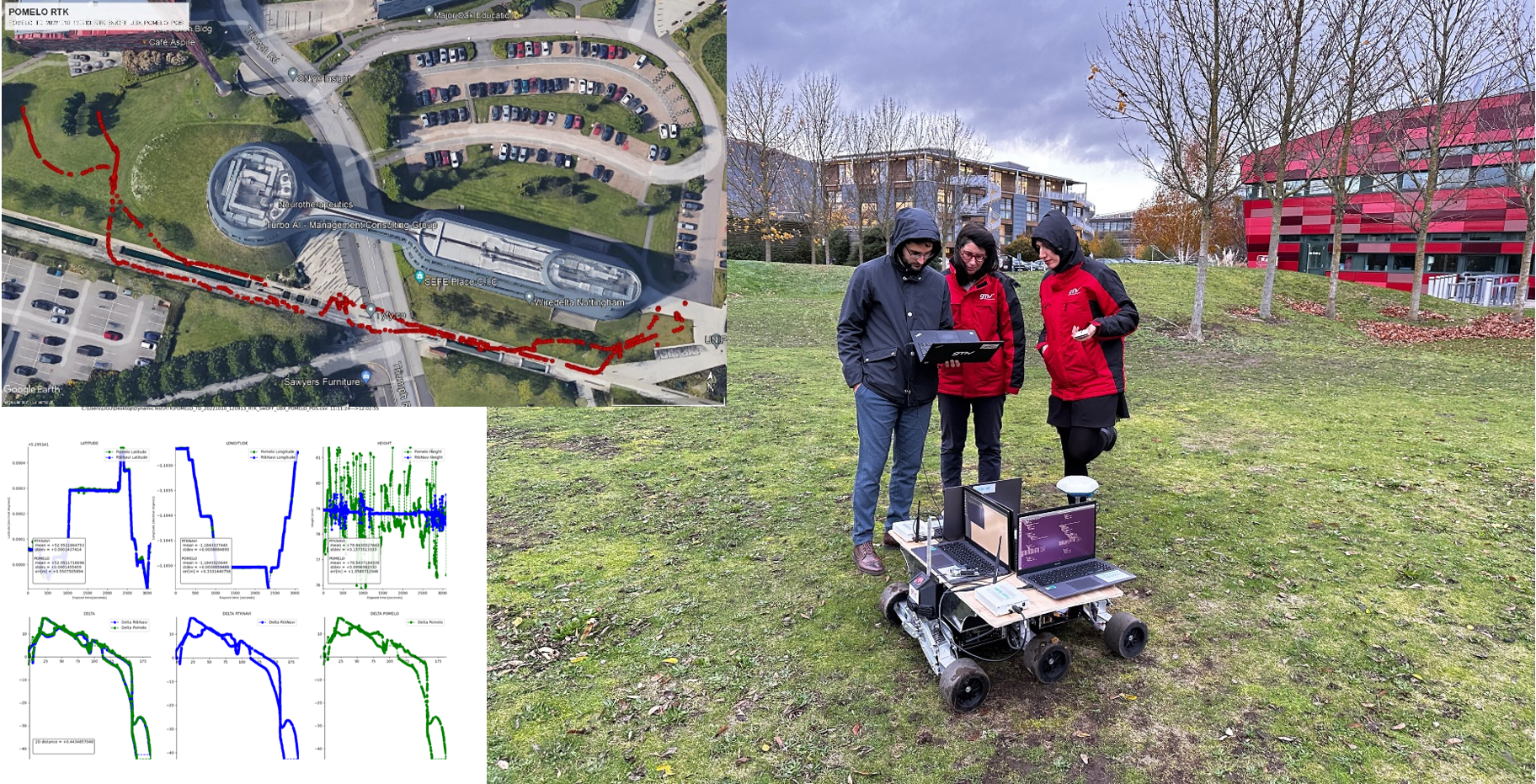
On Thursday, February 02, 2023, GMV NSL Ltd presented, together with its consortium partner Thales Alenia Space France SAS, Telespazio and Géoflex the results of the NAVISP project “Precise Positioning for Mass-Market: Optimal Data Dissemination Demonstrator (POMELO)”. About 50 people from industry and research followed the interesting presentation and the subsequent interactive Q&A session.
Until recently, Real-Time Kinematics (RTK) and Precise Point Positioning (PPP) technologies have been developed and used in particular for professional applications, the price not being affordable for mass-market users. Over the last couple of years, however, impressive breakthroughs have been witnessed for mass-market applications. While multi-frequency multi-GNSS techniques will provide an improved user experience in many consumer settings, this solution alone cannot deliver sufficiently robust and accurate performance to meet the stringent requirements of automotive and industrial applications, unless paired with high accuracy GNSS techniques. A potential way forward consists in a concept that leverages on the latest breakthroughs in GNSS technology and future terrestrial wireless networks to broadcast multi-GNSS augmentation services in real-time at low cost. Terrestrial networks are continuously targeting evolutions of broadcast technology, mainly for audio and video content (e.g. Multimedia Broadcast Multicast Service technology). By allocating a portion of wireless network resources to specific content, a mobile network operator can broadcast a single data stream to all mobile users in a given area, rather than having to provide a separate data stream to each user. In fact, these specific processes can be leveraged on high-accuracy GNSS assistance data to support multi-GNSS positioning techniques.
The objective of this project was therefore to develop and implement a demonstrator for the broadcast of RTK and PP correction aligned with the 3GPPP protocols and architecture for positioning services in 4G and 5G. To this end, terrestrial broadcast technologies were used as a means to provide mass-market users with highly accurate multi-GNSS data and products to allow performing positioning strategies. In addition, the goal was to prove the feasibility of the concept and demonstrate an end-to-end terrestrial broadcast service in real-world operational scenarios and environments. Finally, the data size, rate, and coverage including end-to-end latency and positioning accuracy had to be evaluated. In the scope of the project, a test bed architecture (functional, logical, and physical) was defined by leveraging on existing open standards for mobile wireless networks, infrastructure for terrestrial broadcasting and third party RTK service providers. This test bed was integrated and incorporated laboratory validation for connectivity, communication and decoding of the information stream. Field tests were also defined and performed.
With the support of NAVISP, a novel test bed has been developed that can demonstrate terrestrial transmission of high accuracy multi-GNSS assistance data over cellular signals (i.e., RF signal bands used in mobile telecommunications) and the feasibility of the identified concept, providing insight into key system-level tradeoffs.
As a next step, it is proposed to minimize the current limitations, for example by extending the currently used open library srsLTE. In addition, since the POMELO demonstrator is currently based on SDR hardware and the OTA tests were performed in the 2.4 GHz band, which is close to Wi-Fi and often very noisy and can be subject to interruptions, the use of high-end USRP models and performing OTA transmissions in other frequency bands is being considered for the future. Another idea is to work with mobile network operators and user equipment manufacturers to conduct high-fidelity tests.
The project was carried out in the scope of NAVISP Element 1, which is which is dedicated to technology innovation of the European industry in the wide PNT sector.
More detailed information can be found in the slides of the Final Presentation.