
Filter By
Element 2 - Competitiveness in PNT
-
 Start date: 07/11/2025Duration: 12 MonthsThe I-PoCARS project (Integrated PoC for real-time Automotive useR case with Step) addresses the creation of an enhanced localisation system solution through 5G connectivity and GNSS enhancement as a first step towards a path planning safety solution for autonomous vehicles. The work intends to create a preliminary design for an integrated industry-led framework, linking space, telecommunication…
Subcontractors







-
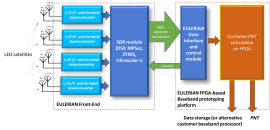 The EULERIAN project aims to demonstrate a flexible RF front-end and digitizer unit that will simplify the activities of designers and developers of LEO PNT receivers. User of the EULERIAN platform will be able to process in real-time a variety of Signals-of-Opportunity (SoOP) from several LEO constellations. The solution will be based on cutting edge highly integrated ASICs, implementing radio…
 -
 Start date: 22/10/2025Duration: 24 MonthsProject HALCON (Hybridization Algorithms and Low‐cost Components for Optimized Navigation) covers the full development of an innovative navigation solution for launch vehicles and space platforms. It advances beyond traditional launcher navigation by exploiting cost‐effective COTS components combined with GNSS and inertial sensor fusion, improving accuracy, robustness, and enabling advanced…
 -
 Start date: 06/10/2025Duration: 24 MonthsThe increasing reliance on Global Navigation Satellite Systems (GNSS) and Satellite-Based Augmentation Systems (SBAS) like EGNOS for aviation navigation has highlighted the critical need for robust performance monitoring and interference mitigation. While EGNOS V2 has significantly improved GNSS accuracy and integrity in European aviation, its evolution to EGNOS V3 will bring dual-frequency,…
Subcontractors

-
 Start date: 06/10/2025Duration: 17 MonthsThe project will develop a distributed edge–core system enabling fleets of mobile PNT agents (e.g., drones, rovers and handheld units) to detect objects in imagery, estimate their absolute positions by fusing agent PNT with multi-view geometry (SfM/Visual SLAM), and visualise results on a central map for operators. The system leverages ML-based feature detection, centralized coordination, and…
 -
 Start date: 01/10/2025Duration: 24 MonthsFreeGNSSNetwork develops a GNSS-independent positioning and timing service for low-power IoT devices by using Sateliot’s LEO satellites to broadcast enhanced orbital and timing data through standard 5G/6G NTN messages, enabling devices to determine their position and maintain synchronization using only Doppler, delay, and Time-Advance measurements. The project will validate this capability…
Subcontractors

-
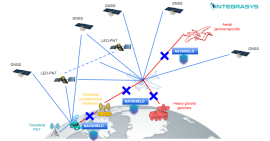 Start date: 01/10/2025Duration: 24 MonthsNAVSHIELD adds efficient and advanced protection to Position, Navigating, and Timing (PNT) already developed systems or future missions, including GNSS (Global Navigation Satellite Systems), LEO-PNT, terrestrial PNT, and inertial navigation. These systems are essential for critical applications in infrastructure, telecommunications, defence, and transport. However, their vulnerability to…
 -
 NAVIGA-EVO is the evolved version of the NAVIGA-VNE (the hybrid navigation unit for VEGA-C launcher) that will reinforce the potential of NAVIGA as the European navigation unit by incorporating capabilities offered by Galileo such as dual-frequency or RF antenna among others and by implementing advanced processing algorithms, which will allow extend the use cases of NAVIGA to new mission scenarios…
Prime contractor

-
 Start date: 19/09/2025Duration: 24 MonthsThe goal of this project is to evolve GMV GSharp®, GMV’s GNSS High Accuracy Positioning solution, into a multi-domain product that integrates Artificial Intelligence (AI), Machine Learning (ML) and dynamics-informed GNSS processing to deliver robust, real time and precise positioning services across terrestrial and space applications.
 -
The number of GNSS jamming and spoofing incidents has dramatically increased around the world and also in the European airspace. Especially GNSS spoofing poses a threat to commercial aviation. This creates an urgent need for jamming and spoofing robust GNSS technology. While such systems exist and have proven their potential, there are currently no solutions available which are qualified for their…
Prime contractor

Subcontractors

Name: German Aerospace Center (DLR)
Country: Germany