

United Kingdom
-
 Start date: 07/10/2026Duration: 12 MonthsThe aim of the GO-PNT project is to identify technical and commercial opportunities for European and Canadian companies in the consumer PNT markets. The project will provide evidence-based understanding of where technological gaps and consumer market opportunities exist, where European and Canadian companies can realistically compete, and what barriers prevent them from doing so. The study will…
Prime contractor

Name: Space Professionals Partnership Limited
Country: United Kingdom
Website: https://space-professionals.com/
Subcontractors

-
 Envisage Smart Mobility is a market-led innovation activity to develop and integrate our RelyMap GNSS Augmentation and Sensor Fusion machine learning software for the ride share micromobility market. This will offer real-world identified benefits in the smarter planning, integration, and operation of micromobility services operating in complex urban environments. Envisage Space will be…
Prime contractor

-
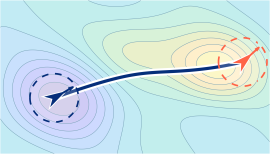 Start date: 30/07/2026Duration: 19 MonthsProject Q-PNT-MAP aims to develop and validate an advanced multi-sensor navigation framework for resilient positioning in GNSS-degraded and GNSS-denied environments. The project exploits quantum magnetic sensing, inertial navigation, AI-assisted magnetic anomaly detection, and magnetic map-building to investigate robust localisation where satellite navigation is unavailable or unreliable. A…
 -
 Start date: 01/07/2026Duration: 18 MonthsHYENA (Hybrid Black-White-Modelling Estimation and Machine Learning Algorithms for PNT Engines) is an ESA NAVISP project developing next generation Positioning, Navigation and Timing (PNT) technologies that combine established estimation techniques with advanced artificial intelligence and machine learning methods. The project investigates how hybrid PNT engines can improve positioning…
 -
 Start date: 25/03/2026Duration: 24 MonthsPASQUALE (Precise and Stable Navigation with Quantum Accelerometer) aims at advancing next-generation positioning, navigation and timing (PNT) technologies. The project explores the integration of quantum inertial sensing with conventional GNSS and inertial systems to enhance navigation accuracy and robustness, particularly in GNSS-degraded or denied environments. At its core, PASQUALE develops…
Subcontractors

-
 Overview This project aims to advance the field of positioning, navigation, and timing (PNT) by integrating Low Earth Orbit (LEO) satellite signals with existing Global Navigation Satellite System (GNSS) technologies. The primary focus is on improving positioning and navigation capabilities, particularly within the professional high-end GNSS market, such as precision agriculture. Objectives:…
Subcontractors


-
 Start date: 18/02/2026Duration: 15 MonthsUPDATE phase 2 will develop an MVP of a UK National PNT Digital Twin. The digital twin will provide “quasi-realistic model” of PNT services services across the UK (including GNSS, ELORAN and the NTC), informed by service status data, that looks, operates and behaves comparably to actual PNT services throughout the UK. The outcome of the project will be an open and modular PNT DT architecture to…
Subcontractors




-
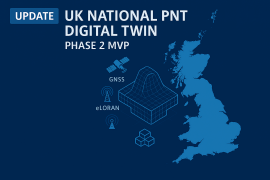 Start date: 18/02/2026Duration: 15 MonthsUPDATE phase 2 will develop an MVP of a UK National PNT Digital Twin. The digital twin will provide “quasi-realistic model” of PNT services services across the UK (including GNSS, ELORAN and the NTC), informed by service status data, that looks, operates and behaves comparably to actual PNT services throughout the UK. The outcome of the project will be an open and modular PNT DT architecture to…
Subcontractors
-
 Start date: 15/02/2026Duration: 22 MonthsThe main objective of this project is to design, develop, and validate a prototype ultra-large synthetic aperture array (ULSA) GNSS receiver for automotive applications, both hardware and software, based on a moving array antenna. While there is a lot of prior art on GNSS antenna array techniques, and some on extending a single GNSS antenna into a synthetic array, there are no documented real-life…
 -
 Start date: 01/12/2025Duration: 18 MonthsBEACON aims to develop, implement, and demonstrate a Multi-array antenna receiver for navigation in C-band from LEO satellites developed under ESA’s FutureNAV LEO-PNT IoD. The development is to be based on a compact and relatively low-cost multi-array antenna with innovative advanced signal processing that exploits both pre- and post-correlation stages. Beamforming will be applied to significantly…
Subcontractors